Best Fountain Pen Inks
Ink is the most personal choice a fountain pen writer makes, and the gap between a flat workhorse ink and one with real shading or shimmer changes how much you enjoy the page. We cover the properties that actually matter for daily writers and collectors: water resistance, dry time, shading behavior, shimmer particle size, and feathering on common papers. Every ink listed here is currently available through a major retailer or direct from the brand.
NibPath may earn a commission from links below . Updated June 2026
What is the best Fountain Pen Inks?
Pilot Iroshizuku Tsuki-yo is the best all-around fountain pen ink for most writers, balancing a saturated teal-green color with smooth flow, moderate dry time, and gentle shading with zero shimmer. Writers who need genuine water resistance should reach for Sailor Sei-boku or Diamine Registrar's Blue-Black instead.
 Top Pick
Pilot Iroshizuku Tsuki-yo Ink
A saturated teal-green dye ink from Pilot's prestige Iroshizuku line with smooth, consistent flow, moderate shading, and zero shimmer. One of the most-recommended inks for daily writers who want a distinctive color without fuss.
Best for Daily journal writers who want a distinctive, smooth ink
 2
2 Sailor Sei-boku Pigmented Ink
A blue-black pigmented ink from Sailor formulated to be safe for fountain pens while delivering strong water resistance and fade resistance. Dries quickly and requires more attentive cleaning than dye inks.
Best for Writers who need water-fast blue-black ink for professional correspondence
 3
3 Diamine Registrar's Blue-Black Ink
A traditional iron gall blue-black ink that dries to a permanent, water-resistant mark. Widely used for legal documents and archival writing. Requires regular cleaning to prevent corrosion.
Best for Writers who need water-resistant or archival ink for documents
 Best Value
Robert Oster Fire and Ice Ink
An Australian boutique ink with a vivid blue-red tonal split that produces dramatic shading and color variation across strokes. Dye-based, not water-resistant, but a show-stopping choice for notebooks and letters.
Best for Writers who prize expressive, high-shading inks for journaling and correspondence
 5
5 J. Herbin 1670 Anniversary Ink
A celebratory collection of shimmer inks with large gold particles suspended in richly pigmented bases. The Rouge Hematite and Bleu Ocean colorways are community favorites. Requires broad nibs and regular flushing.
Best for Writers who want striking shimmer ink for journaling, art, or special correspondence
 6
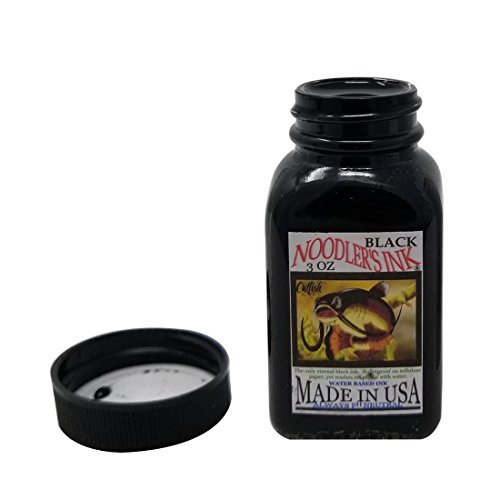
6 Noodler's Bulletproof Black Ink
A permanently bonding black dye ink formulated to be impervious to water, UV, bleach, and many solvents. The go-to archival black for fountain pen writers who need a document-safe ink without switching to pigmented formulas.
Best for Writers who need a permanent, document-safe black ink for archival or professional use
 7
7 Diamine Aurora Borealis Shimmer Ink
A teal-to-blue shimmer ink from Diamine's Shimmertastic line with fine copper and gold particles. More forgiving for medium nibs than the J. Herbin 1670 and priced accessibly.
Best for Writers new to shimmer inks who want a lower-maintenance entry point
The method
How we chose
We evaluated each option on fit, build quality, daily usability, and value. Our top pick, Pilot Iroshizuku Tsuki-yo Ink, earned the spot. The Iroshizuku line is the benchmark for smooth, well-behaved dye inks. Tsuki-yo is the standout color. The comparison above highlights exactly who each pick is best for.
Related guides
Head-to-head comparisons
FAQ
Best Fountain Pen Inks: FAQ
What makes an ink water-resistant?+
Water-resistant inks rely on iron gall chemistry or pigment particles that bond to paper fibers rather than sitting on the surface. Dye-based inks like most Diamine or J. Herbin shades wash off almost completely when wet. Iron gall inks such as Sailor Sei-boku and Diamine Registrar's Blue-Black bond as they oxidize and resist water meaningfully once fully dry.
Can shimmer inks clog my fountain pen?+
Shimmer inks use fine metallic particles that can settle in the nib feed or converter if left sitting for weeks. Flush the pen every two to three weeks if you write daily, or every week if you write occasionally. Broad nibs (M, B, 1.1mm stub) flow enough to keep particles moving. Extra-fine nibs are high-risk with shimmer inks and are better paired with standard dye inks.
Is iron gall ink safe for all fountain pens?+
Most modern iron gall inks at low concentrations are safe for steel and gold nibs and stainless feeds if you flush the pen regularly, every one to two weeks. High-concentration or vintage iron gall formulas are corrosive over time. Avoid leaving any iron gall ink sitting in a pen for more than two weeks without writing.
What does shading mean in a fountain pen ink?+
Shading is the variation in color intensity within a single stroke or letter, where thin strokes appear lighter and broad strokes appear richer. It happens when ink pools slightly in curves and lifts quickly from the paper on fast strokes. High-shading inks reward flexible and broad nibs on absorbent paper; they look flatter on coated or high-GSM paper.
How much ink do I need to buy as a beginner?+
Start with a single 30ml or 50ml bottle from a reputable brand like Pilot Iroshizuku, Diamine, or J. Herbin. A 30ml bottle will last most writers six months to a year of daily journaling. Buying ink samples first from retailers like Goulet Pens or Atlas Stationers is the lowest-risk way to find a color you love before committing to a full bottle.